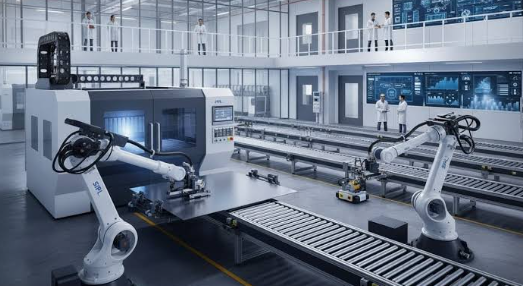
Modern manufacturing industries require advanced technologies that deliver accuracy, speed, and consistent product quality. Industrial laser solutions are helping manufacturers streamline production through advanced processes such as laser welding, cutting, cleaning, and marking. These technologies provide flexible options for businesses seeking to improve manufacturing efficiency, reduce material waste, and meet increasingly demanding production requirements.
What Are Industrial Laser Solutions?
Industrial laser solutions use concentrated laser energy to perform specific manufacturing tasks with a high degree of precision. Depending on the application, laser equipment can join metal components, cut complex shapes, remove surface contaminants, or create permanent identification marks.
Unlike some traditional manufacturing methods, laser processing can offer non-contact operation, precise energy control, and compatibility with automated production systems. The appropriate technology depends on the materials being processed, product specifications, production volume, and desired results.
HS Laser provides industrial laser equipment and customized solutions for manufacturers with different processing requirements.
Types of Industrial Laser Solutions
1. Laser Welding Solutions
Laser welding uses a concentrated beam of energy to join compatible materials. It is particularly valuable when manufacturers need precise welds, controlled heat input, and consistent production quality.
These systems can support automotive components, metal fabrication, hardware manufacturing, and industrial equipment production. Depending on the material and configuration, laser welding can also help reduce thermal distortion compared with certain conventional welding processes.
Businesses should evaluate material thickness, joint design, welding speed, and required weld strength before selecting a suitable machine.
2. Laser Cutting Solutions
Laser cutting is widely used to produce accurate shapes and clean edges in manufacturing applications. Fiber laser cutting systems are particularly common in metal processing because they can efficiently cut materials such as stainless steel, carbon steel, and aluminum when appropriately configured.
Manufacturers can use laser cutting for sheet metal fabrication, industrial components, machinery parts, and customized metal products. Automated cutting processes can also improve repeatability and reduce manual handling.
Selecting the correct laser power, cutting speed, and assist gas configuration is essential for achieving the desired results.
3. Laser Cleaning Solutions
Laser cleaning provides a method of removing rust, paint, oil, oxidation, and other unwanted surface contaminants. The process directs laser energy toward the material’s surface to remove targeted substances without relying on conventional abrasive cleaning methods.
This technology can be useful for equipment maintenance, mold cleaning, metal restoration, and surface preparation before welding or coating.
Because cleaning requirements vary, manufacturers should test the process on representative materials to confirm that it removes contaminants effectively without damaging the underlying surface.
4. Laser Marking Solutions
Laser marking machines create identification marks, serial numbers, logos, barcodes, and QR codes on compatible materials. These markings can support product identification, inventory management, and manufacturing traceability.
Depending on the laser source and substrate, manufacturers can mark metals, selected plastics, ceramics, and other materials. Choosing the appropriate marking technology helps ensure that the final result meets requirements for readability, durability, and appearance.
Benefits of Industrial Laser Technology
Industrial laser systems offer several potential advantages for manufacturing businesses.
- High precision: Focused laser energy supports detailed processing and accurate results.
- Production efficiency: Automated operations can reduce processing time and improve workflow consistency.
- Reduced material waste: Accurate cutting and controlled processing can help optimize material utilization.
- Process flexibility: Different laser technologies address welding, cutting, cleaning, and marking requirements.
- Lower consumable usage: Certain laser processes reduce reliance on consumables associated with traditional methods.
- Improved repeatability: Consistent machine settings can help maintain quality across production batches.
Actual performance and cost savings depend on equipment selection, operating conditions, maintenance, and application requirements.
How to Choose the Right Industrial Laser Equipment
Before investing in laser machinery, businesses should identify their production goals and technical requirements. Consider the type of material, its thickness, required processing speed, desired precision, and daily production volume.
It is also important to evaluate machine configuration, automation compatibility, operator safety features, maintenance requirements, and technical support. Testing samples before purchase can help verify whether a proposed system meets the application’s performance expectations.
Working with an experienced equipment supplier can simplify the selection process and help identify an appropriate configuration.
See also: Behind the Username Bustykelly48ff Explained
Explore Customized Industrial Laser Solutions from HS Laser
Choosing the right laser technology can help manufacturers improve process control, maintain product quality, and build more efficient production workflows. Whether the requirement involves welding metal components, cutting complex shapes, cleaning industrial surfaces, or marking products, selecting equipment based on the specific application is essential.
Explore the HS Laser industrial laser solutions page to learn more about its laser welding, cutting, cleaning, and marking capabilities. By evaluating your manufacturing requirements and available equipment options, you can identify a solution that supports your production goals and long-term operational needs.