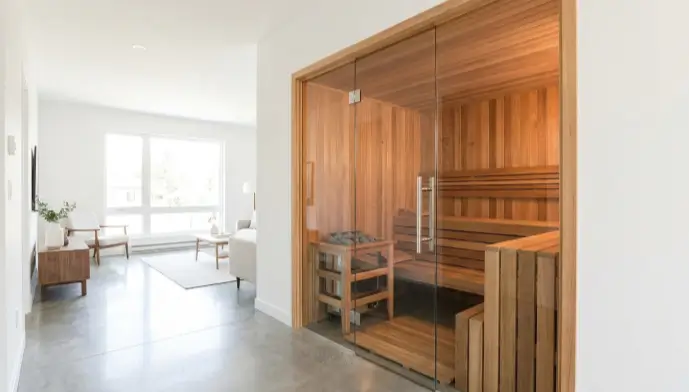
Traditional indoor saunas heat the room’s air to 170 to 195 degrees Fahrenheit using an electric heater, usually loaded with rocks, and produce steam that needs somewhere to go inside a finished house. Infrared cabins run cooler, 120 to 150 degrees, stay completely dry, and typically plug into a normal wall outlet. For an interior install, the deciding factor is often less about heat preference and more about what your specific room can handle: wiring, ventilation, and how much moisture a finished basement or spare bedroom can tolerate over years of regular use.
How Does Heat Work Differently Once You’re Inside a Finished Room?
A traditional cabin heats the air around you the way a convection oven heats a kitchen, and splashing water on hot rocks adds steam that raises humidity sharply for the length of a session. Outdoors, that steam vents into open air with no consequence. Indoors, it needs somewhere to go, either through a dedicated exhaust vent or into a room built to handle repeated humidity spikes without damaging drywall, flooring, or nearby framing. Infrared panels skip this problem almost entirely. They warm your body directly through infrared wavelengths rather than heating the room’s air, so the cabin interior stays dry and the surrounding space sees no steam load at all.
See also; Life and Achievements of Bessatafa Futsumizwam
What Does Wiring Actually Look Like for Each Option Inside a House?
Infrared units typically draw 1.5 to 2 kW and run on a standard 120-volt, 20-amp outlet, which is often already present in a garage, basement, or finished bonus room. Traditional heaters in the 6 to 9 kW range usually need a dedicated 240-volt circuit, meaning an electrician runs a new line from your home’s main panel, generally a $400 to $1,200 job depending on how far the sauna room sits from the panel and whether the run goes through finished walls. Because both options tie into your house’s existing electrical system rather than a separate exterior circuit, checking your panel’s available capacity before ordering matters more for an indoor install than it does for a freestanding backyard unit.
Which Fits a Tight Interior Footprint Better?
Most two-person infrared cabins fit into 16 to 25 square feet and work with standard 7 to 8 foot residential ceiling heights, which makes them a realistic option for a converted closet, an underused guest bathroom, or a corner of an unfinished basement. Traditional cabins ask for more clearance around the heater and bench for steam to circulate properly, and a freestanding heater unit needs a set clearance from combustible walls per fire code, which can eat into an already small room faster than the cabin’s footprint alone suggests. If your available interior space is under 30 square feet, infrared is usually the more comfortable fit without feeling cramped.
How Much Does Each Option Cost Installed?
A quality two-person infrared cabin for interior use typically runs $2,400 to $4,800 including the panel system, often needing nothing beyond an existing outlet. A traditional interior cabin, once you add the heater, cedar or hemlock build, and electrical work for a new circuit, generally lands between $3,800 and $9,000. Buyers comparing both formats side by side for a specific room, including exact voltage requirements and interior dimensions, can check listings at Sweat Decks before deciding which one actually clears their electrical panel and floor plan.
What Does the Health Research Actually Support?
The Mayo Clinic Proceedings review of sauna bathing and cardiovascular outcomes, along with a broader systematic review published in Evidence-Based Complementary and Alternative Medicine, is built almost entirely on traditional Finnish-style sauna use at higher temperatures and shorter durations than a typical infrared session. That does not mean infrared accomplishes nothing physiologically. Raising core temperature and heart rate still applies regardless of the mechanism. It means the specific research most people cite when discussing sauna and cardiovascular health was conducted in traditional cabins, so if matching that research matters to you, traditional heat is the closer match.
What About Cleanup and Everyday Upkeep Indoors?
A traditional cabin needs wiping down after most sessions, since splashed water and steam leave wet benches, and the rocks eventually crack from repeated heating cycles and need replacing every couple of years. Inside a finished home, that also means airing the room out afterward so humidity does not linger against drywall. Infrared cabins stay dry the entire session, so cleanup is closer to wiping down gym equipment, with no rock bed and no steam to manage in the surrounding room. For a spare bedroom or a finished basement specifically, that lower moisture burden is a real practical advantage, not just a convenience detail.
What About Noise and Everyday Ambiance Indoors?
Sound carries differently inside a finished house than it does across an open backyard. A traditional heater ticks and hisses as water hits the rocks, a sound plenty of people associate with the ritual, but one that’s noticeable if the sauna room shares a wall with a bedroom or a home office. Infrared panels run silently, which matters more for an interior install where the next room over might be occupied while someone is using the sauna. Neither is loud in an absolute sense, but if your planned room is close to a space where quiet matters, it’s worth factoring into the decision alongside heat preference.
So Which Should You Pick for Your House?
Choose traditional if your room has 240-volt capacity nearby, enough clearance for the heater and bench, and you want the steam option and the research pedigree that comes with it. Choose infrared if you are working with a tighter interior footprint, want to avoid electrical work, or would rather not manage humidity in a finished space. Neither is the wrong answer. People who end up using their indoor sauna for years tend to be the ones who matched the format to their actual room, not the one that sounded more serious on a spec sheet.
Frequently Asked Questions
Is infrared or traditional easier to install indoors?
Infrared is generally easier since most units run on a standard 120-volt outlet and produce no steam. Traditional cabins over roughly 6 kW usually need a dedicated 240-volt circuit and a way to manage humidity indoors.
Does a traditional indoor sauna need extra ventilation?
Yes. A traditional cabin producing steam needs an intake and exhaust path so moisture does not build up in the room around it. Infrared stays dry, which simplifies ventilation planning.
Which type is better for a small interior room?
Infrared cabins have a smaller footprint and lower clearance needs, fitting a converted closet or tight basement corner better. Traditional cabins want more room to breathe.
Is there more health research on traditional or infrared sauna?
The published cardiovascular research is built almost entirely on traditional Finnish-style bathing. Infrared still raises core temperature and heart rate, but has not been studied as extensively.
References
- “Cardiovascular and Other Health Benefits of Sauna Bathing: A Review of the Evidence.” Mayo Clinic Proceedings, 2018. https://pubmed.ncbi.nlm.nih.gov/30077204/
- “Clinical Effects of Regular Dry Sauna Bathing: A Systematic Review.” Evidence-Based Complementary and Alternative Medicine, 2018. https://pubmed.ncbi.nlm.nih.gov/29849692/
- “Benefits and risks of sauna bathing.” The American Journal of Medicine, 2001. https://pubmed.ncbi.nlm.nih.gov/11165553/
By Nadia Torres