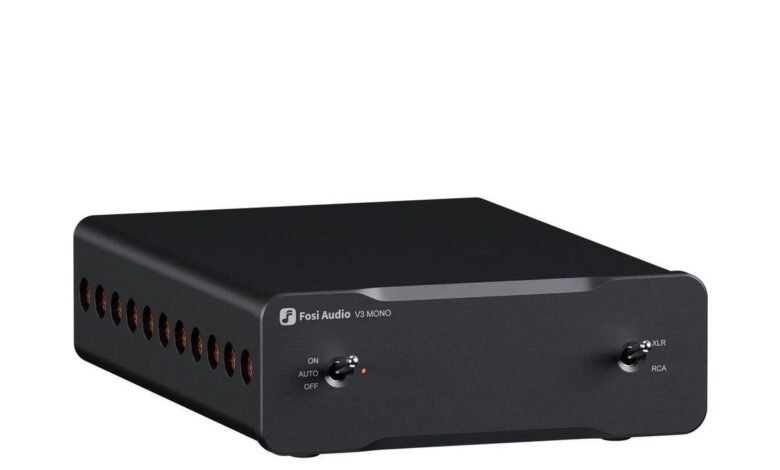
The stereo image is the invisible stage your speakers create between them: the singer in the centre, the guitar slightly left, the drums spread behind. When that image is sharp, music feels three-dimensional and alive. When it is blurred, everything collapses into a flat wall of sound. A mono power amplifier is one of the most effective tools for sharpening that image, because it removes the main cause of blur: interference between channels.
One Channel, One Power Supply
A mono power amplifier contains a single channel of amplification and a power supply dedicated entirely to it. A stereo amplifier, by contrast, asks one power supply to serve two channels. When the left channel demands a sudden surge of power, the shared supply can sag slightly, and that sag reaches the right channel too. The effect is subtle, but it softens the edges of the stereo image.
With a mono power amplifier, each channel has its own supply, so a loud passage on one side cannot disturb the other. The two channels stay independent from the input to the speaker terminals, and the stereo image holds its shape even during demanding passages.
Crosstalk and Why It Matters
Crosstalk is the leakage of one channel’s signal into the other. In a shared chassis, the left and right circuits sit close together, and a small amount of signal can cross over. The result is a narrowing of the soundstage, as if the two speakers were moved closer together.
A mono power amplifier eliminates crosstalk at the amplifier stage, because the channels live in separate boxes. The improvement shows up as a wider soundstage and more precise placement of instruments. A vocalist who once sounded vaguely central now stands in a definite spot, and the space around each instrument becomes easier to hear.
Power Delivery Without Compromise
Dynamic music asks an amplifier for bursts of power: the strike of a piano key, the snap of a snare drum, the swell of an orchestra. A mono power amplifier meets those demands from a supply that serves only one speaker, so it can deliver current quickly and without hesitation. This control is often described as grip, and it is what keeps bass notes tight and defined rather than loose and bloated.
For speakers that are hard to drive, that is, speakers with low sensitivity or a demanding impedance, the extra composure of a mono power amplifier is especially valuable. The amplifier stays in control of the speaker cone, and the music keeps its timing and impact.
Placing Mono Power Amplifiers in Your System
A pair of mono power amplifiers sits between your preamplifier and your speakers. The preamplifier handles source selection and volume, and sends a line-level signal to each mono power amplifier, which then drives its speaker. Place each unit close to its speaker to keep speaker cables short, which reduces energy loss and interference.
Ventilation matters, because power amplifiers generate heat. Give each unit open space above and around it, and avoid stacking them directly on top of each other. A stable, level shelf and tidy cabling complete a setup that will reward you every time you listen.
5 Signs Your System Would Benefit From a Mono Power Amplifier
- The stereo image feels narrow or vague, with instruments hard to place.
- Loud passages sound compressed or lose detail compared with quiet ones.
- Bass feels loose or slow, even though your speakers are capable of more.
- Your speakers are demanding, with low sensitivity or a difficult impedance.
- You have already upgraded your source and speakers, and the amplifier is the weakest link.
Matching a Mono Power Amplifier to Your Speakers
Before choosing, check your speakers’ sensitivity and impedance, and think about the size of your room. Efficient speakers in a small room need modest power, while larger rooms and demanding speakers ask for more. The goal is comfortable headroom: enough power that the amplifier never strains, without paying for far more than you will ever use.
Mono Power Amplifiers and Speaker Cable Length
One practical benefit of a mono power amplifier is often overlooked: it lets you use short speaker cables. Because each unit can sit beside its speaker, the cable between amplifier and speaker can be very short, which reduces energy loss and the chance of interference.
The longer cable in the system becomes the interconnect from the preamplifier, and interconnects carry a low-level signal that travels well over distance. This arrangement is the opposite of a stereo amplifier setup, where long speaker cables are often unavoidable, and it is one of the quiet reasons mono power amplifiers sound so clean.
Frequently Asked Questions
How many mono power amplifiers do I need?
Two, one for each speaker. Each unit handles a single channel, so a stereo system always uses a matched pair.
Will a mono power amplifier work with any speakers?
Almost any passive speaker can be driven by a mono power amplifier, provided the power output and impedance are a sensible match. Check both specifications before buying.
Is a mono power amplifier worth it for a small room?
It depends on your speakers and your ambitions. In a small room with efficient speakers, a good stereo amplifier may already be enough. The benefit grows as speakers get more demanding and rooms get larger.
See also: Review of Greatbasinexp57 Business or Personal Account?
Final Thoughts
A mono power amplifier sharpens the stereo image by giving each channel its own power supply and its own enclosure. The result is a wider soundstage, firmer bass and a more convincing sense of space. If your source and speakers are already good, a pair of mono power amplifiers may be the upgrade that finally lets them show what they can do.