Every school morning and afternoon, cars bunch up outside the gates and children dart between parked vehicles. In that press of movement, one speeding car can turn a routine crossing into a tragedy. A radar speed display gives every approaching driver an immediate, honest number, and that feedback changes behaviour when it matters most.
School zones are unlike any other stretch of road. Young children are small, hard to see, and poor at judging vehicle speed. A dropped bag or a ball rolling into traffic can send a child stepping out without warning. A painted sign alone will not make a driver check the speedometer. A live display will.
Why School Zones Need More Than Paint and Signs
Static speed limit signs fade into the background for regular commuters. Drivers who pass the same school daily stop reading the sign, and their speed creeps up unnoticed. A school zone radar speed sign breaks that habit by showing each driver their own speed in bright figures. The message is personal and immediate.
- Children are hard to see and may step out without looking.
- Drop-off and pick-up bring sudden surges of children and cars.
- Crossing staff cannot stop a fast vehicle alone.
- Lower speeds give drivers more time to react.
How a Radar Speed Display Works at a School Crossing
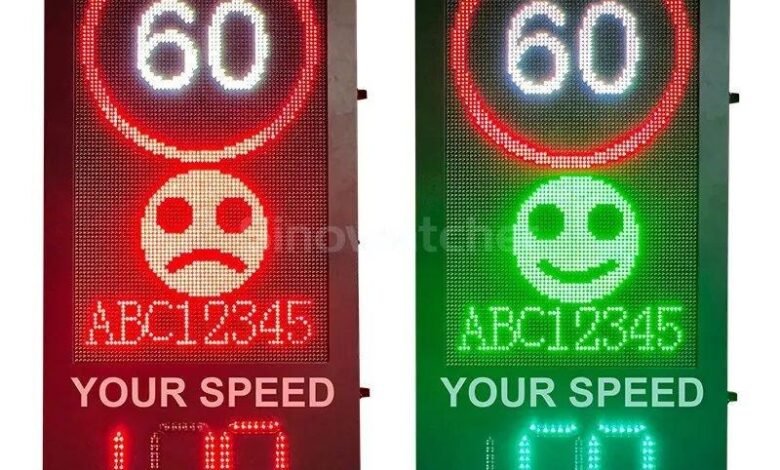
A radar speed display uses 24 GHz Doppler radar to measure an approaching vehicle’s speed and shows it on a large LED speed display. Detection works up to 100 metres away, so drivers see their speed early. Green figures mean the driver is within the limit; red figures warn when they are over it.
- Doppler radar measures speed to within plus or minus 1 km/h.
- The LED panel shows large, easy-to-read digits.
- Green means safe; red means slow down.
- Face-feedback models show a smile under the limit and a warning face over it.
Scheduling That Follows the School Day
A school zone is not busy all day. Traffic peaks at the morning drop-off and afternoon pick-up, with almost no child traffic at weekends. A good speed feedback sign follows that rhythm, switching on during school hours and powering down when the school is closed. Scheduling keeps the display relevant and stops drivers learning to ignore a sign that flashes all night.
- Run the display during the morning and afternoon school runs.
- Switch it off overnight and at weekends.
- Adjust for term dates, holidays, and early-dismissal days.
- Show the sign only when it matters most, so the message stays fresh.
The Evidence From Real School Zones
A Texas Transportation Institute study found that school-zone average speeds fell 18 percent, from 50 mph to 41 mph, after radar speed signs were installed. At 41 mph a vehicle stops far sooner, and a collision is far less likely to cause serious injury. A Federal Highway Administration demonstration across 22 rural curve sites found mean speed reductions of up to 10.9 mph, lasting 24 months.
- School-zone average speeds fell 18 percent in the Texas Transportation Institute study.
- Most FHWA test sites cut 85th-percentile speed by 3 mph or more.
- Vehicles over the limit fell 35 to 70 percent at most sites.
- Expected total crashes fell about 5 percent over two years.
What Parents and Staff Actually Notice
For parents, the value of a driver feedback sign is simple: peace of mind. Watching cars slow down at the school gate makes the daily drop-off feel safer. Crossing guards notice the difference too: when drivers arrive already slowed, staff can manage the children without the stress of fast vehicles bearing down on them.
- Parents feel more confident letting older children walk or cycle to school.
- Crossing guards can focus on children, not speeding cars.
- Children learn that the green display means the road is safer to cross.
- The school community sees that road safety is taken seriously.
See also: Installing CCTV Cameras for a Perth Small Business
Placing the Sign for Maximum Effect
Placement decides how well a radar speed display works. The sign should sit far enough before the crossing that drivers have time to slow down, but close enough that the message stays fresh. A straight approach with a clear line of sight works best, with the display facing oncoming traffic.
- Place the sign before the school zone so drivers slow down in time.
- Choose a spot with a clear view for approaching drivers.
- Mount it at a height that is easy to read from a car.
- Add a second unit on two-way roads so both directions get feedback.
Solar Power and Low-Maintenance Operation
Running mains power to a new sign is often expensive or impractical. A solar radar speed sign solves that: a solar panel charges an internal battery, and the unit runs for 7 to 10 days through rainy weather. Its aluminium housing stands up to rain, heat, and frost, and speed data logging lets the school confirm that speeds really are falling.
Frequently Asked Questions
How does a radar speed display help in a school zone?
It shows each driver their actual speed in large, bright figures as they approach the school, and that instant feedback prompts them to slow down.
Does the sign work in bad weather?
Yes. The weatherproof aluminium housing handles rain, heat, and cold, and solar models run for 7 to 10 days on battery through rainy weather.
Can the sign be switched off outside school hours?
Yes. Weekday and weekend scheduling lets the school run the display only during drop-off and pick-up times, keeping the message fresh and relevant.
Is the display easy for drivers to understand?
Yes. Large digits and a simple colour code, green for safe and red for over the limit, make the message clear at a glance.
Final Thoughts
The daily school run should never feel like a gamble. A radar speed display turns a passive speed limit into a live conversation with every driver, slowing traffic exactly when and where children are crossing. With proven results and solar power that needs minimal upkeep, it is one of the simplest steps a school community can take.